

How much does a Shopify store cost in the USA? A complete breakdown for US brands

Updated at
18.11.2026
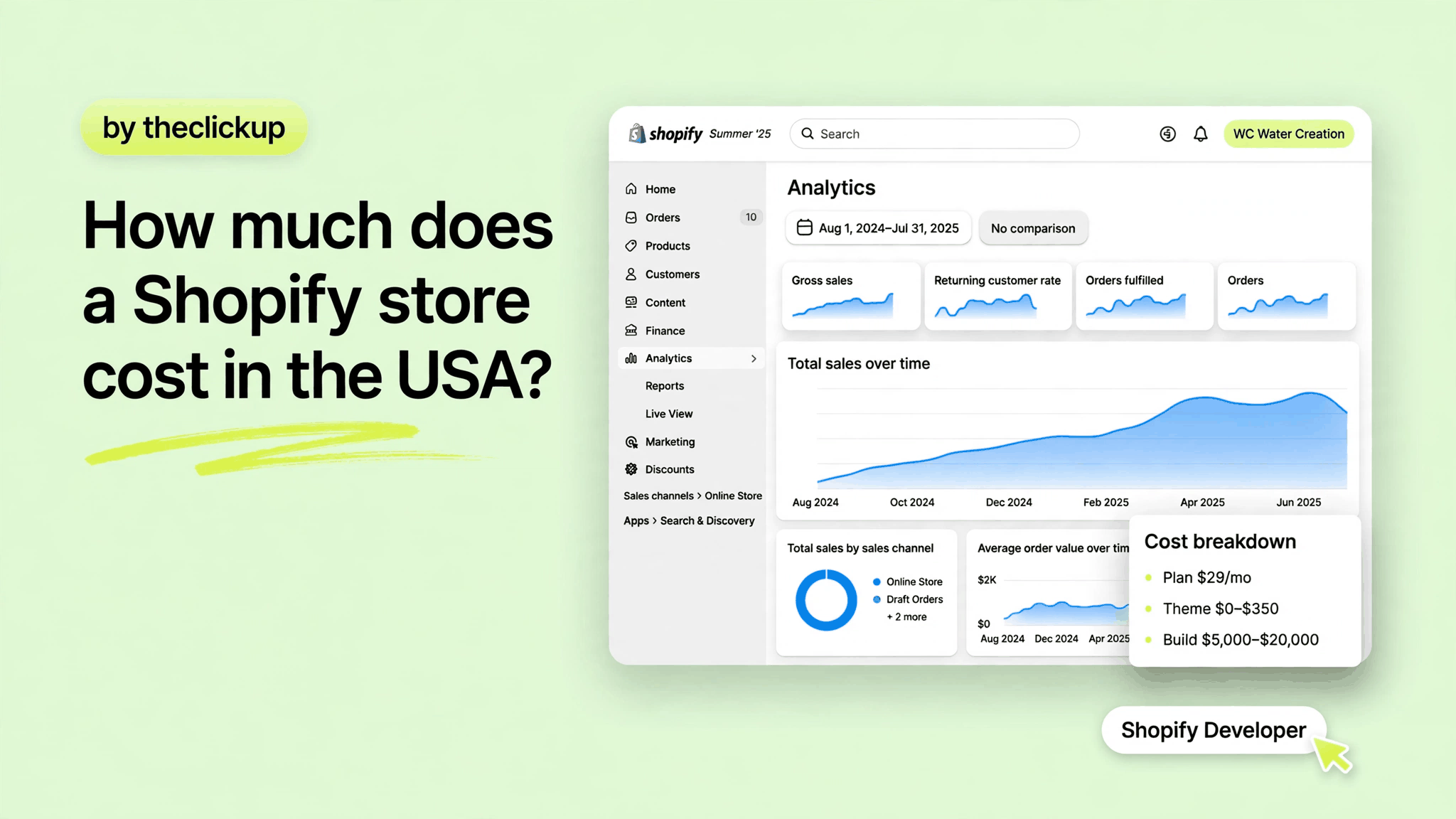
A Shopify store in the USA costs $39 a month for the Basic plan alone — but the plan is the smallest part of the bill. A custom theme build typically runs $20,000–$60,000, plus $500–$2,000 a month for apps, according to ranges reported by US agencies.
This guide breaks down every line item — plan, theme, development, apps, and migration — so you can budget the first year of your store honestly, without surprises after launch.


What actually makes up the cost of a Shopify store?
A Shopify quote is never one number. It is five separate decisions, and each one moves the total on its own:
- The Shopify plan — your monthly subscription, from Basic up.
- The theme — a free or premium off-the-shelf theme, or a custom theme built for your brand.
- Design & development — the pages, sections, checkout, and custom functionality.
- Apps & integrations — reviews, search, subscriptions, email, ERP, and payments.
- Content & migration — products, images, copy, order history, and redirects from your old platform.
- Launch, QA & ongoing care — testing, fixes, and the work that keeps the store fast after launch.
When an agency quotes you a number, ask which of these six it includes. Two quotes for the “same” store can differ by tens of thousands of dollars simply because one of them leaves half the list out.
Shopify store cost breakdown
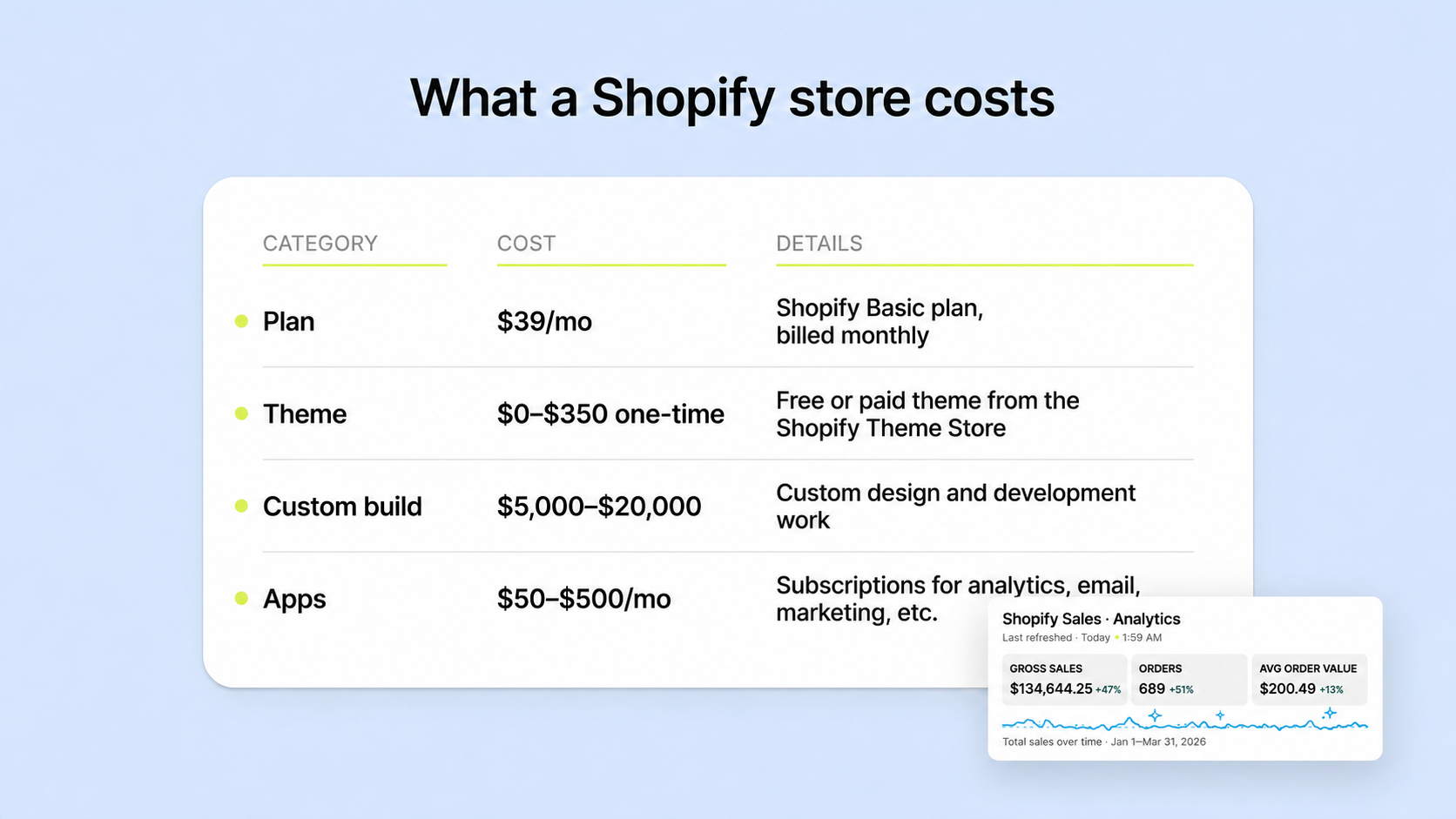
| What you are paying for | Typical range | What drives it |
| Shopify plan (Basic) | $39/month ($29/month billed yearly) | Shopify’s public pricing. Higher plans cost more as your sales grow. |
| Custom theme build | $20,000–$60,000 one-off | Range reported by Splash Creative. Template count, custom sections, motion, and checkout work. |
| Apps & integrations | $500–$2,000/month | Range reported by Splash Creative. Reviews, search, subscriptions, email, ERP, and payments. |
| Migration from another platform | Varies with catalog size | Product count, order and customer history, URL redirects, custom functionality. |
| Redesign of an existing store | Less than a new build | Discovery already exists — but design, development, and content migration remain full scope. |
What pushes a Shopify store from cheap to expensive?
Three things move a store from the low end of the range to the high end — and none of them is the Shopify plan itself.
Custom checkout and a complex catalog
A store with ten products and one checkout flow is a different build from a store with ten thousand products, variants, bundles, and B2B pricing. Every rule in the catalog — filters, search, variants, subscriptions — is design and development work.
Integrations that touch real systems
Connecting Shopify to an ERP, a warehouse, a CRM, or a payment provider you already use is where budgets grow. Each integration needs mapping, testing, and someone accountable when it breaks.
Content, SEO, and conversion work after launch
The build is not the end of the spending. Product content, search optimization, and conversion testing decide whether the store earns its build cost back — budget for them as part of the first year, not as an afterthought.
Shopify vs WooCommerce: which costs more?
Shopify bundles hosting, security, and updates into one subscription — the cost is predictable, and the platform takes care of the infrastructure. WooCommerce spreads the cost out: hosting, plugins, and maintenance are separate bills, and someone has to keep them working together.
For most US brands, Shopify is the more predictable option. WooCommerce can look cheaper at the start and more expensive to maintain over a year. The honest comparison is not plan versus plugin — it is total cost of ownership over twelve months, including the hours your team spends on upkeep.
If you are choosing between the two, start with what your team will actually maintain — and see how we scope a build on our Shopify store design & development page.
How to budget your first year on Shopify
Split the first year into four lines, and budget each one separately:
- The plan and the apps — monthly, from $39 a month for Basic plus whatever your apps cost.
- The one-off build — theme, design, development, and migration.
- Content and launch — product content, redirects, QA, and the launch itself.
- Growth — ads and SEO, kept as a separate budget from the build. Our Meta Ads services cover the paid side once the store is ready to convert.
Stores that blow their budget usually do it on the fourth line — they start advertising before the store is ready, and pay to send traffic to pages that do not convert.
Not sure where your store lands in this range? Send us your catalog size, your current platform, and the features you need — we will tell you what drives your number before we quote it.
Final thoughts
Shopify store cost reflects scope, not the platform. A $39-a-month plan can carry a $50,000 build, and a cheap build can carry a store that never converts — which is the most expensive outcome of all.
Before discussing numbers, define what the store has to do: how many products, which integrations, what the checkout must handle, and what “success” looks like in the first year. The estimate becomes far more accurate once the scope is clear — and the store you get is the one you actually asked for.
FAQ
How much does a Shopify store cost in the USA?
The plan starts at $39 a month on Basic — $29 a month if billed yearly. The build is the bigger number: a custom theme build typically runs $20,000–$60,000, plus $500–$2,000 a month for apps, according to ranges reported by US agencies. Your exact number depends on catalog size, custom sections, and integrations.
What is the monthly cost of running a Shopify store?
At minimum, the plan — $39 a month on Basic — plus the apps you install. Growing stores typically spend $500–$2,000 a month on apps alone, before ad spend, which is a separate budget.
How much does a custom Shopify theme cost?
The range reported by US agencies is $20,000–$60,000 for a custom theme build. A premium off-the-shelf theme costs far less but limits how far the design can go; custom sections, motion, and checkout work push the number up.
Is Shopify cheaper than WooCommerce?
It depends on what you count. Shopify bundles hosting, security, and updates into one subscription. WooCommerce spreads the cost across hosting, plugins, and maintenance. For most US brands Shopify is more predictable — WooCommerce can be cheaper upfront and more expensive to maintain over a year.
Read more

 advantage

 Book a call

Fill out the form
or brief with questions



 LinkedIn
 Instagram
Welcome to The ClickUp privacy notice.
The ClickUp respects your privacy and is committed to protecting your personal data. This privacy notice will inform you as to how we look after your personal data when you visit our website (regardless of where you visit it from) and other sites we own and operate. And tell you about your privacy rights and how the law protects you.
We may change the privacy policy from time to time to reflect changes to the products and services that we provide and how we process your personal data.
We will not share your information with any third party outside of our organization, other than as necessary to fulfil your request if any."
INFORMATION WE COLLECTWhen you visit our website, our servers may automatically log the standard data provided by your web browser. This data is considered “non-identifying information”, as it does not personally identify you on its own. It may include:
- Your computer’s Internet Protocol (IP) address;
- Your browser type and version;
- The pages you visit;
- The time and date of your visi;
- The time spent on each page;
We may ask for personal information, such as your name and email address. This data is considered “identifying information”, as it can personally identify you. We only request personal information relevant to providing you with a service, and only use it to help provide or improve this service.
We collect information by fair and lawful means, with your knowledge and consent. We also let you know why we’re collecting it and how it will be used. You are free to refuse our request for this information, with the understanding that we may be unable to provide you with some of your desired services without it.
We will only process personal data and communicate with you if:
1. You have given us consent to the processing of your personal data and communicating for one or more specific purposes i.e. requesting products or services from us, downloading material or information from our website or submitting a contact us form.
2. Performance of a contract
3. Where we have a legitimate interest for contacting you in relation to our products and services
DATA PROCESSING AND STORAGEWe only retain personal information for as long as necessary to provide a service, or to improve our services in future. While we retain this data, we will protect it within commercially acceptable means to prevent loss and theft, as well as unauthorised access, disclosure, copying, use or modification. That said, we advise that no method of electronic transmission or storage is 100% secure, and cannot guarantee absolute data security.
Rights and choices of individuals:
- See what data we have about you, if any;
- Change/correct any data we have about you;
- Have us delete any data we have about you;
- See what security measures we apply to your data;
- Express any concern you have about our use of your data;
You may opt out of any future contacts from us at any time. You can do the following at any time by contacting us via the email address given on our website: theclickup.com
Got questions or want to discuss a project?


