

5 Meta Ads mistakes fintech and ecommerce brands make (and how to fix them)

Updated at
18.11.2026
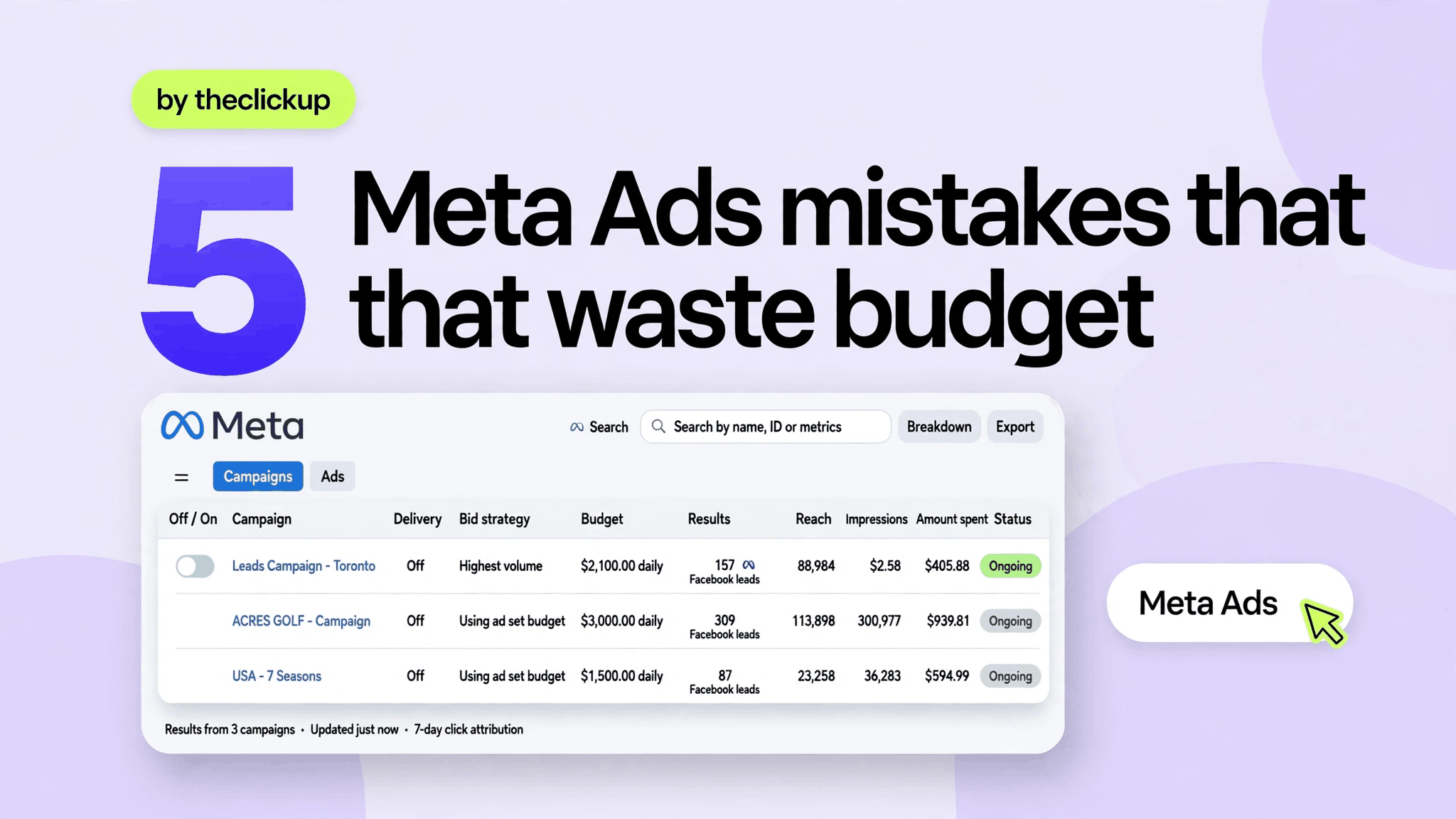
Most wasted Meta Ads budget comes from five fixable mistakes: no funnel, targeting that is too broad, creative that looks like an ad, tracking you cannot trust, and scaling before the data is ready.
This guide walks through each one — what it looks like, why it burns money, and the fix we use for fintech and ecommerce brands in the US.


The 5 Meta Ads mistakes that waste budget
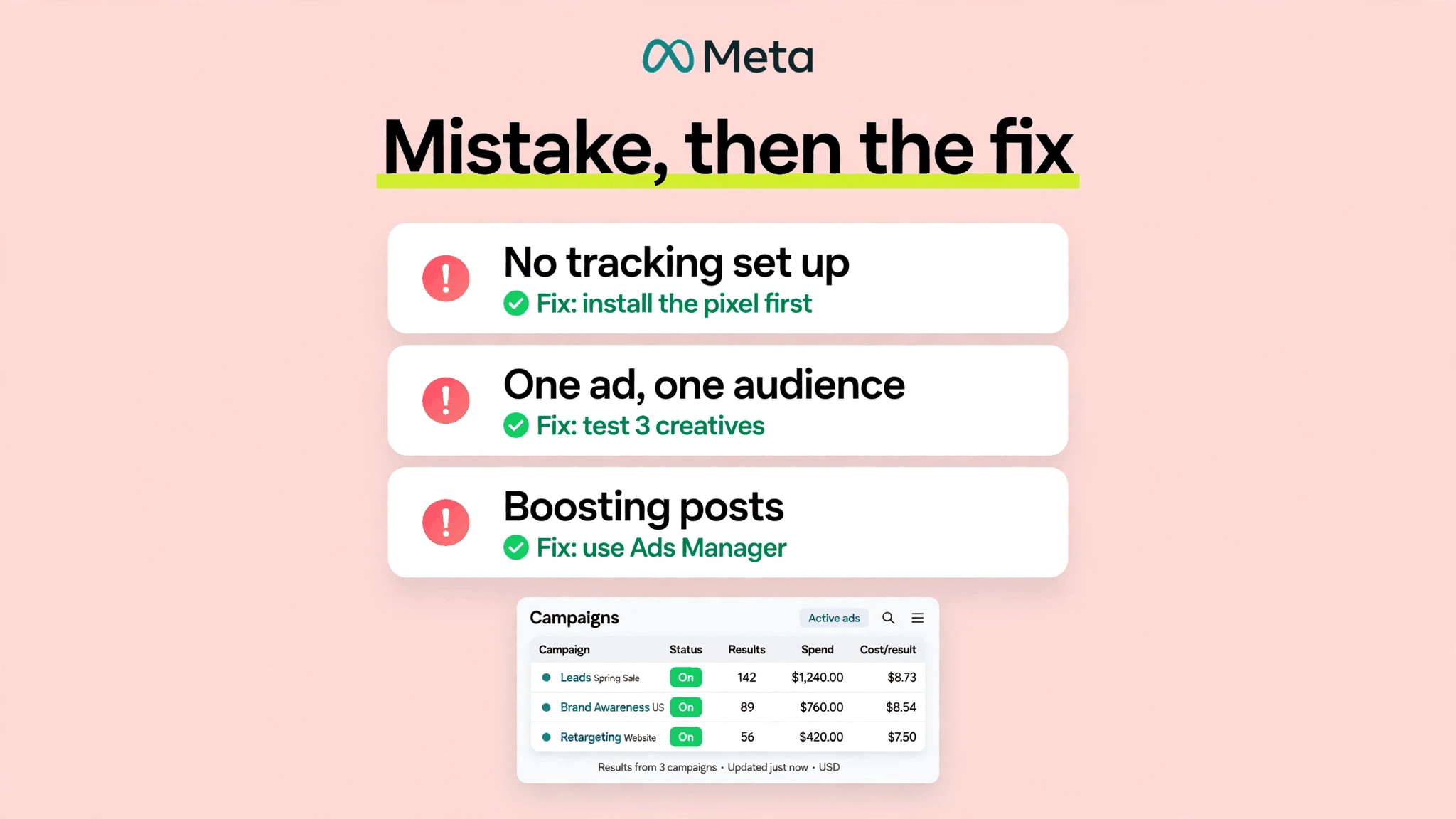
Meta Ads rarely fail because the platform is broken. They fail because the account repeats the same five mistakes — usually all at once. Here they are, in the order we check them during an audit.
Mistake 1: Sending cold traffic straight to a generic page
Cold audiences do not know you yet. Sending them to your homepage — or to a product page built for people who already decided — asks for a purchase before you have earned any trust. The click costs the same; the conversion does not happen.
The fix: match the page to the audience. Cold traffic goes to a page that explains the offer in one screen; warm traffic goes to the product or signup page. And build a retargeting pool from every visit, so the first click is the start of the funnel, not the end of it.
Mistake 2: Targeting everyone — or no one
“Everyone in the USA, 18–65” is not targeting — it is a donation to Meta. The opposite — an audience of a few thousand people — never leaves the learning phase and never produces a signal you can act on.
The fix: layer your audiences. Start from real buyers with lookalikes, add interest and behavior layers, and exclude existing customers and recent converters so you stop paying to reach people who already bought. For fintech, keep audience definitions compliant — no targeting that implies personal financial circumstances.
Mistake 3: Creative that looks like an ad
People scroll past anything that looks like a banner. Stock photos, corporate headlines, and the same three creatives running for months all get ignored — and ignored ads cost the same per impression as ads that stop the scroll.
The fix: make creative that belongs in the feed: real product, real people, a hook in the first two seconds, and one clear message per ad. Test hooks systematically — five hooks on one proven concept beats five unrelated concepts — and retire creative the moment its performance fades.
Mistake 4: Tracking you cannot trust
If the pixel is misfiring, the Conversions API is not set up, or UTMs are missing, you are optimizing on fiction. Worse, judging performance on platform-reported conversions alone hides the gap between what Meta claims and what your store or CRM actually recorded.
The fix: set up the pixel and the Conversions API together, tag every ad with UTMs, and reconcile platform numbers with Shopify or your analytics every week. The numbers that matter are the ones your business can verify — not the ones the ad platform reports.
Mistake 5: Scaling before the data is ready
Killing an ad after one bad day, or doubling the budget after one good day, are the same mistake: deciding on noise. Meta needs enough conversions to learn, and a small test budget cannot produce a reliable signal in a day.
The fix: give each test a real budget and enough time to produce a signal, then scale gradually — small, repeated increases instead of sudden jumps. As a sanity check, WordStream’s 2026 benchmarks put the median cost per lead at $27.39, traffic CPC at $0.60, and lead CPC at $1.80. Use them to spot a broken campaign, not as a target to hit.
A healthy Meta Ads account is boring to look at: one funnel, a few proven creatives, clean tracking, and budgets that move slowly. The excitement belongs in creative testing — not in budget changes.
What good Meta Ads look like for fintech and ecommerce
For fintech, good ads are compliant first: no income or returns claims, clear disclosures, and landing pages that build trust before asking for personal data. Fintech converts on trust — the ad opens the conversation, and the funnel closes it.
For ecommerce, good ads are product-led: catalog ads, real product creative, and retargeting that follows the shopper’s actual journey. And they only work if the store is ready — a fast, clear product page converts ad traffic, while a slow or confusing one wastes it. If the store is the weak link, fix it first with our Shopify store design & development team, then scale the ads with Meta Ads services.
How much should you budget?
Ad spend is your money to set — it is separate from management. Agency retainers are commonly reported at $750–$5,000+ a month, or 10–20% of spend. Whatever the split, start with a test budget that can actually produce a signal, and scale only what proves itself.
Final thoughts
Meta Ads waste budget when the fundamentals are skipped: the funnel, the audience, the creative, the tracking, and the patience to let data accumulate. Fix those five, and the same spend starts working harder — often before you raise the budget at all.
And if your account already shows the symptoms — high CPCs, low conversion, numbers that never match your store — audit the five mistakes in order. The fix is usually earlier in the list than you expect.
FAQ
How much do Meta Ads cost in the USA?
Ad spend is yours to set. WordStream’s 2026 benchmarks put the median cost per lead at $27.39, traffic CPC at $0.60, and lead CPC at $1.80. Agency management is commonly reported at $750–$5,000+ a month or 10–20% of spend. Your numbers depend on audience, offer, and creative.
How long do Meta Ads take to work?
Expect a testing phase first — usually a few weeks of learning before you judge performance. Ads killed after a day never had a chance; ads scaled after a day of good results usually collapse. Give each test enough budget and time to produce a signal.
Do Meta Ads work for fintech brands?
Yes, with guardrails: compliant creative, no income or returns claims, clear disclosures, and landing pages that build trust before asking for personal data. Fintech converts on trust — the ad opens the conversation, the funnel closes it.
Should I run Meta Ads to my Shopify store?
Yes — if the store is ready. Ads amplify whatever the store already does: a fast, clear product page converts ad traffic; a slow or confusing one wastes it. Fix the store first, then scale the ads.
Read more
 advantage

 Book a call

Fill out the form
or brief with questions



 LinkedIn
 Instagram
Welcome to The ClickUp privacy notice.
The ClickUp respects your privacy and is committed to protecting your personal data. This privacy notice will inform you as to how we look after your personal data when you visit our website (regardless of where you visit it from) and other sites we own and operate. And tell you about your privacy rights and how the law protects you.
We may change the privacy policy from time to time to reflect changes to the products and services that we provide and how we process your personal data.
We will not share your information with any third party outside of our organization, other than as necessary to fulfil your request if any."
INFORMATION WE COLLECTWhen you visit our website, our servers may automatically log the standard data provided by your web browser. This data is considered “non-identifying information”, as it does not personally identify you on its own. It may include:
- Your computer’s Internet Protocol (IP) address;
- Your browser type and version;
- The pages you visit;
- The time and date of your visi;
- The time spent on each page;
We may ask for personal information, such as your name and email address. This data is considered “identifying information”, as it can personally identify you. We only request personal information relevant to providing you with a service, and only use it to help provide or improve this service.
We collect information by fair and lawful means, with your knowledge and consent. We also let you know why we’re collecting it and how it will be used. You are free to refuse our request for this information, with the understanding that we may be unable to provide you with some of your desired services without it.
We will only process personal data and communicate with you if:
1. You have given us consent to the processing of your personal data and communicating for one or more specific purposes i.e. requesting products or services from us, downloading material or information from our website or submitting a contact us form.
2. Performance of a contract
3. Where we have a legitimate interest for contacting you in relation to our products and services
DATA PROCESSING AND STORAGEWe only retain personal information for as long as necessary to provide a service, or to improve our services in future. While we retain this data, we will protect it within commercially acceptable means to prevent loss and theft, as well as unauthorised access, disclosure, copying, use or modification. That said, we advise that no method of electronic transmission or storage is 100% secure, and cannot guarantee absolute data security.
Rights and choices of individuals:
- See what data we have about you, if any;
- Change/correct any data we have about you;
- Have us delete any data we have about you;
- See what security measures we apply to your data;
- Express any concern you have about our use of your data;
You may opt out of any future contacts from us at any time. You can do the following at any time by contacting us via the email address given on our website: theclickup.com
Got questions or want to discuss a project?


