

Meta Ads creative testing guide for Shopify brands in 2026

Updated at
19.11.2026
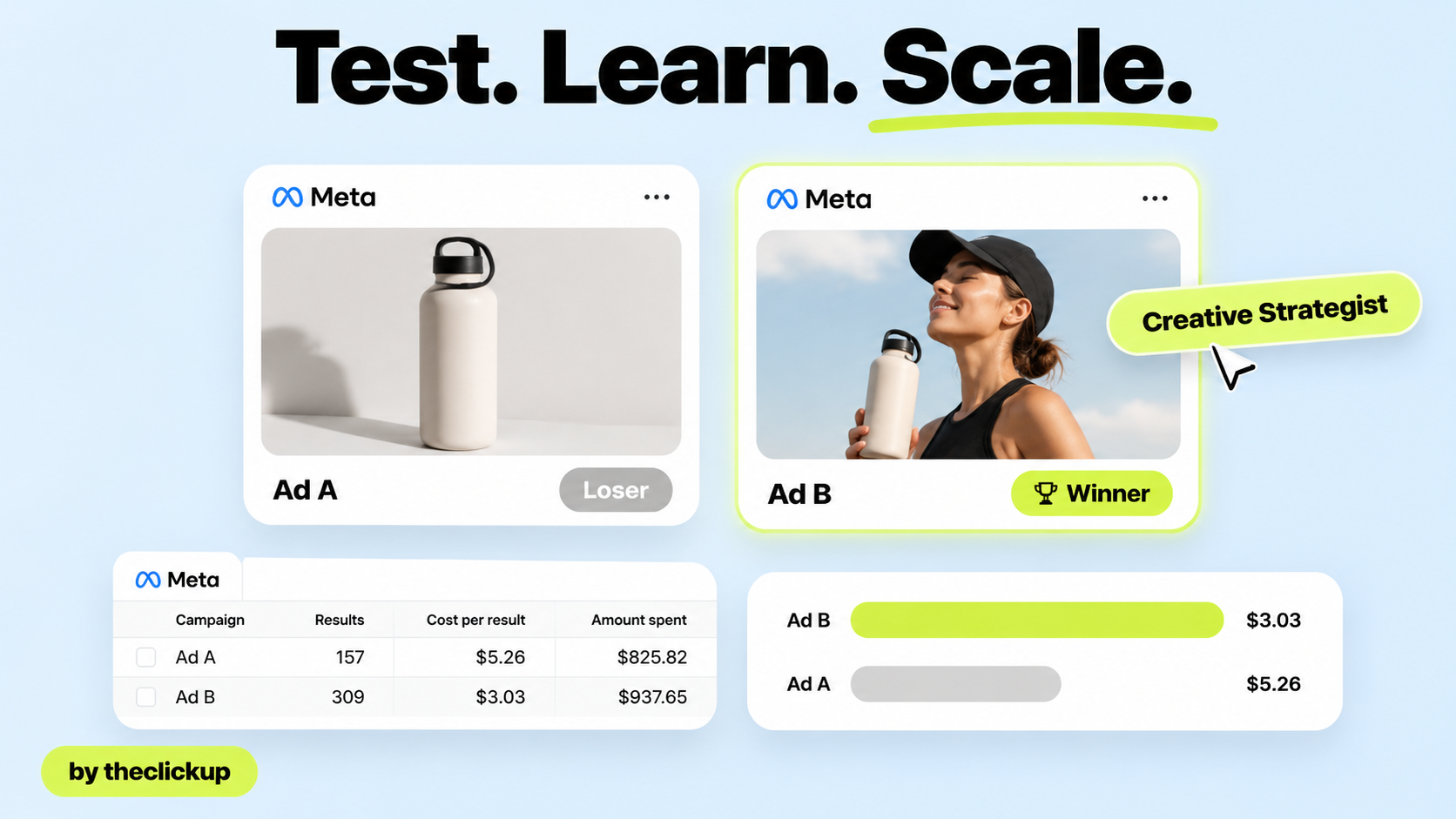
Creative testing is not guessing — it is one variable at a time, a fixed budget, and a decision written down.
This guide shows how Shopify brands test Meta Ads creative in 2026: what to test first, how to structure a test so the result means something, what to measure, and when to kill an ad or scale it.


Creative testing: the short answer
Creative testing means changing one thing in an ad at a time — the hook, the format, the proof or the offer — and running the versions against each other until one clearly wins. For a Shopify brand, the order that matters is: hooks first, then formats, then proof, then offers. A test needs a fixed budget (around $100 or 3–5 days per version, whichever comes first) and one decision metric: cost per purchase. Everything else is a hint, not a result.
The reason most brands test badly is not laziness — it is testing everything at once. A new video, a new headline, a new audience and a new offer launched together tells you nothing when the result comes in, because you cannot tell which change did it. The sections below give you a structure that actually answers the question.
What to test, in order
| What you test | What changes | Why it matters |
| Hook | The first 3 seconds | The highest-leverage test — a better hook lifts everything after it |
| Format | Video vs image vs carousel | Find the format your buyers respond to before you polish anything else |
| Proof | Review vs demo vs number | Find out what your buyers trust — it is rarely what you expect |
| Offer | 20% off vs free shipping | One offer at a time, or you will never know which one sold |
| Audience | Cold vs warm vs past buyers | The same ad needs different copy for each group |
| Landing page | Product page vs collection | The ad promises, the page delivers — test the pair, not the ad alone |
How to structure a test that means something
Three rules keep a test honest.
1. One variable, one test
Change one thing and keep everything else identical — the same audience, the same budget, the same landing page, the same offer. If two things change, the result is a guess. This is the rule brands break most often, usually because they are in a hurry — and it is the rule that costs the most when it is broken.
2. A fixed budget and a fixed end
Decide the budget and the end date before you start: around $100 per version or 3–5 days, whichever comes first. A test without an end date runs forever, and a test you stop early because the first day looked good is not a test — it is a hope. Write the start, the budget and the decision date down before you launch.
3. One decision metric
Judge the test on cost per purchase — the money it took to get one order. Clicks, likes and cheap traffic are hints, not results: a cheap click that never buys is the most expensive click there is. If the store is new and purchases are rare, use cost per add-to-cart as a stand-in, and switch to cost per purchase as soon as the volume allows.
What to measure — and when to kill or scale
Measure three numbers and ignore the rest. Cost per purchase is the decision. Click-through rate tells you whether the hook worked. Cost per add-to-cart tells you whether the landing page kept the promise. When the cost per purchase climbs for three days straight, the creative is tired — refresh it, do not raise the budget. When a version wins clearly on cost per purchase after the full test budget, scale it slowly: raise the budget in steps, not all at once, and watch the cost per purchase as you go — a winning ad that is scaled too fast often stops winning.
Kill fast and without sentiment. An ad that has spent its test budget without a purchase is not "about to work" — it has told you its answer. The money it would keep spending is the budget for the next test. Brands that win on Meta are not the ones with the best first ad; they are the ones that kill the losers fastest and test the most. For the ad copy itself, our guide to writing Meta Ads that convert covers the hook, proof and offer structure, and Meta Ads vs Google Ads covers where Meta fits in the budget.
The weekly testing routine
Run this every week, same day, same time:
- Monday — decide: read last week’s tests, kill the losers, scale the winner in steps, and write down what you learned in one line per test.
- Tuesday — make: build the next test from the winner — three new hooks on the winning format, or two new proofs on the winning hook. Never test from scratch when you have a winner to build on.
- Wednesday — launch: one variable, one budget, one end date, written down before you press publish.
- Friday — check, do not decide: look at the early numbers for errors only — a broken link, a wrong price, an ad that never ran. Do not kill a test on Friday’s numbers; the test ends when the budget or the date says so.
- Next Monday — decide again: the routine is the system. Management for a store’s Meta Ads typically runs $1,000–$5,000 a month or 10–20% of ad spend, as reported by US agencies — and most of that fee is this routine, not the targeting. If you want one team writing the ads and building the store they land on, see our Meta Ads service and our Shopify service.
Keep a simple log: date, what changed, budget, result, decision. After a month, the log is the most valuable thing in the ad account — it tells you what your buyers respond to, and it stops the team from re-testing the same losers.
Testing this week? Start with the hook test in section 3 — or ask us to audit your ad account before you spend.
The verdict: test one thing, decide on purchases, repeat
Creative testing is a routine, not a project. One variable at a time, a fixed budget, cost per purchase as the decision, and a weekly rhythm of kill, scale and make. Hooks first, then formats, then proof, then offers — and a log that remembers what you learned.
Start this week: take your best-selling product, write three hooks from real customer words, and run them for 3–5 days. The winner is the first entry in your log — and the first ad that was chosen by your buyers, not by a meeting.
FAQ
How long should I run a Meta Ads creative test?
Around $100 of spend per version or 3–5 days, whichever comes first. Decide the budget and the end date before you launch, and do not stop the test early because the first day looked good — the result needs the full test to mean anything.
What should I test first in Meta Ads creative?
The hook — the first three seconds. A better hook lifts everything after it, and it is the cheapest thing to test: the same product, three different first lines. Then test formats, then proof, then offers.
What metric decides a creative test?
Cost per purchase — the money it took to get one order. Click-through rate tells you whether the hook worked, and cost per add-to-cart tells you whether the landing page kept the promise, but the test is decided on purchases.
How often should I refresh Meta Ads creative?
When the cost per purchase climbs for three days straight, the creative is tired — refresh it. Meta ads tire in weeks, not months, so plan new hooks and formats as a routine, not as a rescue.
Read more

 advantage

 Book a call

Fill out the form
or brief with questions



 LinkedIn
 Instagram
Welcome to The ClickUp privacy notice.
The ClickUp respects your privacy and is committed to protecting your personal data. This privacy notice will inform you as to how we look after your personal data when you visit our website (regardless of where you visit it from) and other sites we own and operate. And tell you about your privacy rights and how the law protects you.
We may change the privacy policy from time to time to reflect changes to the products and services that we provide and how we process your personal data.
We will not share your information with any third party outside of our organization, other than as necessary to fulfil your request if any."
INFORMATION WE COLLECTWhen you visit our website, our servers may automatically log the standard data provided by your web browser. This data is considered “non-identifying information”, as it does not personally identify you on its own. It may include:
- Your computer’s Internet Protocol (IP) address;
- Your browser type and version;
- The pages you visit;
- The time and date of your visi;
- The time spent on each page;
We may ask for personal information, such as your name and email address. This data is considered “identifying information”, as it can personally identify you. We only request personal information relevant to providing you with a service, and only use it to help provide or improve this service.
We collect information by fair and lawful means, with your knowledge and consent. We also let you know why we’re collecting it and how it will be used. You are free to refuse our request for this information, with the understanding that we may be unable to provide you with some of your desired services without it.
We will only process personal data and communicate with you if:
1. You have given us consent to the processing of your personal data and communicating for one or more specific purposes i.e. requesting products or services from us, downloading material or information from our website or submitting a contact us form.
2. Performance of a contract
3. Where we have a legitimate interest for contacting you in relation to our products and services
DATA PROCESSING AND STORAGEWe only retain personal information for as long as necessary to provide a service, or to improve our services in future. While we retain this data, we will protect it within commercially acceptable means to prevent loss and theft, as well as unauthorised access, disclosure, copying, use or modification. That said, we advise that no method of electronic transmission or storage is 100% secure, and cannot guarantee absolute data security.
Rights and choices of individuals:
- See what data we have about you, if any;
- Change/correct any data we have about you;
- Have us delete any data we have about you;
- See what security measures we apply to your data;
- Express any concern you have about our use of your data;
You may opt out of any future contacts from us at any time. You can do the following at any time by contacting us via the email address given on our website: theclickup.com
Got questions or want to discuss a project?


