

Shopify vs WooCommerce for US brands: the honest comparison

Updated at
18.11.2026
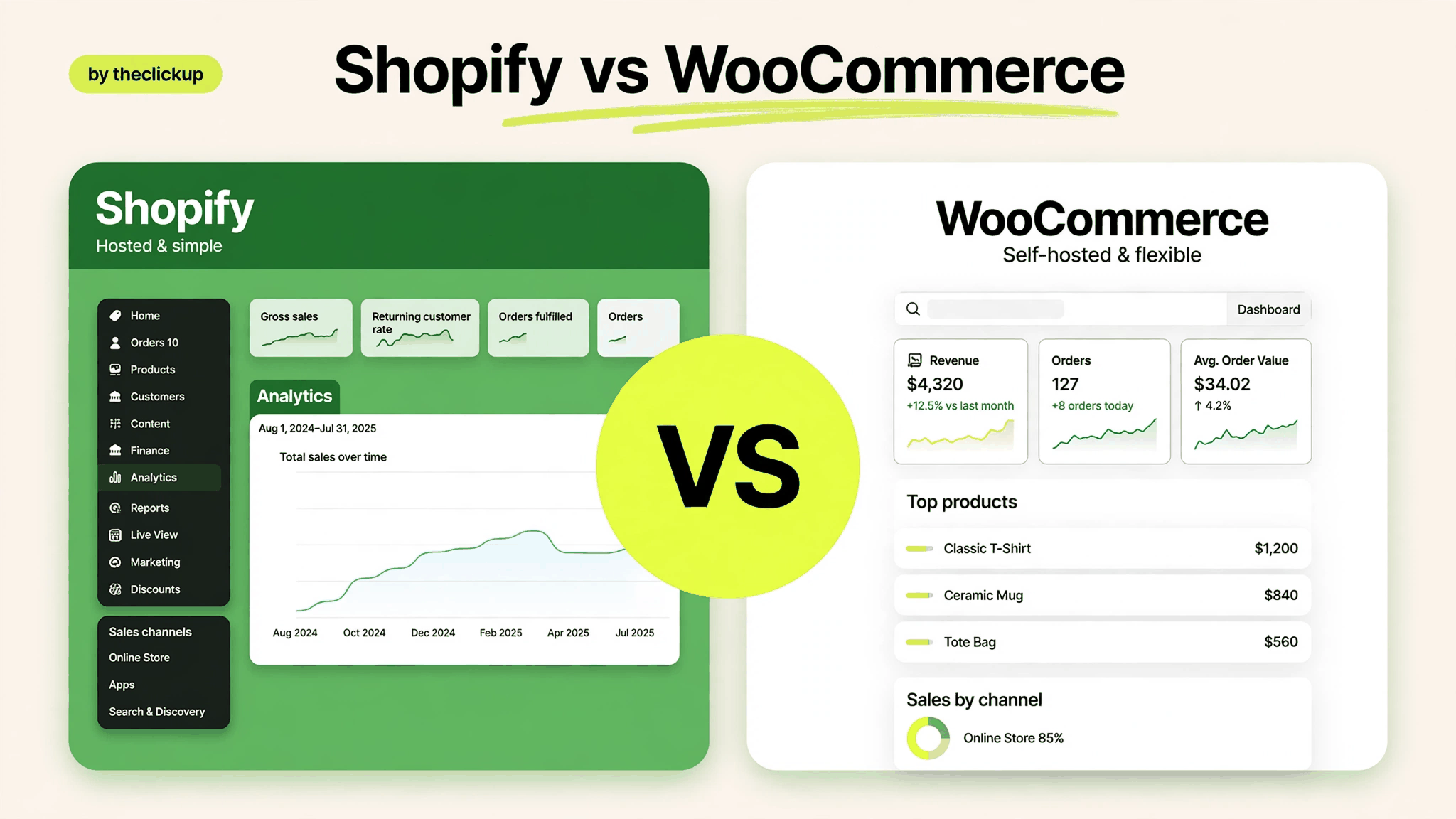
Shopify costs $39 a month on Basic and WooCommerce can start near free — but the plan price is the worst way to compare them. Over twelve months, hosting, maintenance, checkout and the hours your team spends keeping the store running decide the real number.
This comparison puts Shopify and WooCommerce side by side on the six things that actually move the total — hosting, build, monthly cost, checkout, customization and upkeep — so you can pick the platform your team will still be happy with a year from now.


The short answer
For most US brands that want to sell, not maintain software, Shopify is the safer default: one subscription covers hosting, security and updates, and checkout is built to convert. WooCommerce wins when you need deep customization, you already run WordPress well, and you have someone to own maintenance. The rest of this guide shows the numbers behind that sentence.
- Hosting & security — included in Shopify’s subscription; a separate bill and a separate job on WooCommerce.
- Upfront build — theme and custom development on both, but WooCommerce adds setup and plugin configuration.
- Monthly running cost — plan plus apps on Shopify; hosting plus plugins plus maintenance on WooCommerce.
- Checkout — Shopify’s checkout is tested on millions of stores; WooCommerce checkout depends on your theme and plugins.
- Customization — WooCommerce is open source and can be changed at any level; Shopify trades some freedom for stability.
- Upkeep — updates, backups and fixes are Shopify’s job; on WooCommerce they are yours, or your agency’s.
When an agency quotes you a number, ask which of these six it includes. Two quotes for the “same” store can differ by tens of thousands of dollars simply because one of them leaves half the list out.
Shopify vs WooCommerce, side by side
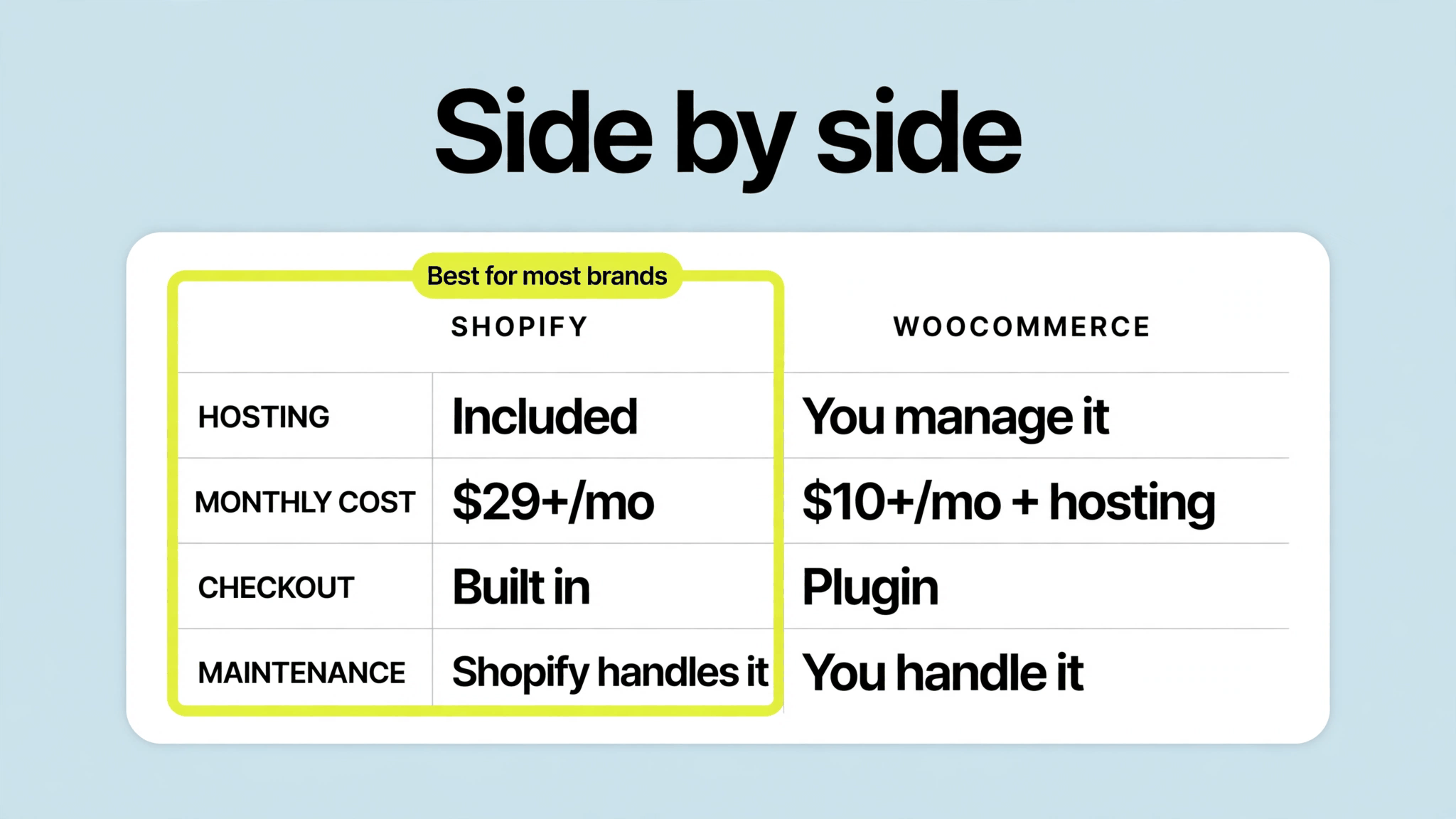
| What you are comparing | Shopify | WooCommerce |
| Hosting & security | Included in the plan | Separate hosting, SSL and security bills |
| Upfront build | Theme + custom development | Theme + development + setup and plugins |
| Monthly running cost | $39/month Basic, plus apps | Hosting + plugins, varies with traffic |
| Checkout | Built in, tested at scale | Depends on theme and plugins |
| Maintenance | Handled by Shopify | Updates, backups and fixes are yours |
Where Shopify wins
Three things keep US brands on Shopify once they have run a store for a year — and none of them shows up in the plan price.
Predictable cost, month after month
One subscription covers hosting, security, updates and support. There is no surprise hosting renewal, no emergency fix after a plugin update, and no separate bill for keeping the store online. Finance teams like it because the number is the same every month.
Checkout that converts
Shopify’s checkout is tested across millions of stores and tuned for mobile. Fewer fields, faster loads, Apple Pay and Shop Pay built in — the details that decide whether a visitor becomes a buyer are already handled before your designers start.
Support when something breaks
When checkout fails at midnight, there is one company to call. On WooCommerce, the answer depends on whether the problem is the host, the theme or a plugin — and each of them points at the other two.
Where WooCommerce wins
WooCommerce is open source, so there is almost nothing you cannot change: the checkout flow, the data model, the admin, the integrations. If your store needs logic Shopify cannot express — custom pricing rules, unusual product types, deep WordPress integration — WooCommerce is the honest choice.
It also fits teams that already run WordPress well. If your marketing site is WordPress, your team knows the admin, and you have a developer who owns updates, WooCommerce can be cheaper to run and completely yours — no platform rules, no app-store fees, no forced changes.
The deciding question is not which platform is better — it is which one your team will actually maintain. If the answer is “we want to sell, not maintain software”, see how we scope a build on our Shopify store design & development page.
How to choose in one afternoon
Score both platforms on the four lines below, for your catalog — not a generic store:
- Catalog and checkout — how many products, variants and bundles, and what the checkout must handle.
- Your team — who updates, backs up and fixes the store when something breaks.
- Integrations — ERP, warehouse, CRM and payments, and who owns each connection.
- Growth — ads and SEO, kept as a separate budget from the build. Our Meta Ads services cover the paid side once the store is ready to convert.
If Shopify wins three or more of the four lines, the decision is made. If WooCommerce wins, make sure the maintenance line has a named owner and a monthly budget — that is where WooCommerce stores quietly get expensive.
Not sure which platform fits your store? Send us your catalog size, your current platform, and the features you need — we will tell you which one costs less over twelve months, before we quote it.
Final thoughts
Shopify vs WooCommerce is not a price comparison, it is a maintenance comparison. A $39-a-month plan can carry a $50,000 build, and a “free” plugin can carry a store that costs your team ten hours a week — which is the most expensive outcome of all.
Before choosing, define what the store has to do: how many products, which integrations, what the checkout must handle, and who keeps it running. The platform becomes obvious once the scope is clear — and the store you get is the one you actually asked for.
FAQ
Is Shopify cheaper than WooCommerce?
It depends on what you count. Shopify bundles hosting, security and updates into one subscription, starting at $39 a month on Basic. WooCommerce spreads the cost across hosting, plugins and maintenance — it can look cheaper upfront and cost more over a year once your team’s time is counted.
Which is better for a small US business?
For most small US brands, Shopify: you get hosting, security, checkout and support in one place, and you can launch without a developer on call. WooCommerce fits businesses that already run WordPress and have someone to own updates and fixes.
Can you migrate from WooCommerce to Shopify?
Yes. Migration cost depends on product count, order and customer history, URL redirects and custom functionality. A small catalog with standard data migrates quickly; a large catalog with custom fields takes longer. Ask for a migration audit before committing to a number.
Does Shopify charge transaction fees?
Shopify charges a transaction fee when you use a third-party payment provider instead of Shopify Payments, and the rate depends on your plan. With Shopify Payments there is no extra Shopify transaction fee — you pay the card processing rate only.
Read more

 advantage

 Book a call

Fill out the form
or brief with questions



 LinkedIn
 Instagram
Welcome to The ClickUp privacy notice.
The ClickUp respects your privacy and is committed to protecting your personal data. This privacy notice will inform you as to how we look after your personal data when you visit our website (regardless of where you visit it from) and other sites we own and operate. And tell you about your privacy rights and how the law protects you.
We may change the privacy policy from time to time to reflect changes to the products and services that we provide and how we process your personal data.
We will not share your information with any third party outside of our organization, other than as necessary to fulfil your request if any."
INFORMATION WE COLLECTWhen you visit our website, our servers may automatically log the standard data provided by your web browser. This data is considered “non-identifying information”, as it does not personally identify you on its own. It may include:
- Your computer’s Internet Protocol (IP) address;
- Your browser type and version;
- The pages you visit;
- The time and date of your visi;
- The time spent on each page;
We may ask for personal information, such as your name and email address. This data is considered “identifying information”, as it can personally identify you. We only request personal information relevant to providing you with a service, and only use it to help provide or improve this service.
We collect information by fair and lawful means, with your knowledge and consent. We also let you know why we’re collecting it and how it will be used. You are free to refuse our request for this information, with the understanding that we may be unable to provide you with some of your desired services without it.
We will only process personal data and communicate with you if:
1. You have given us consent to the processing of your personal data and communicating for one or more specific purposes i.e. requesting products or services from us, downloading material or information from our website or submitting a contact us form.
2. Performance of a contract
3. Where we have a legitimate interest for contacting you in relation to our products and services
DATA PROCESSING AND STORAGEWe only retain personal information for as long as necessary to provide a service, or to improve our services in future. While we retain this data, we will protect it within commercially acceptable means to prevent loss and theft, as well as unauthorised access, disclosure, copying, use or modification. That said, we advise that no method of electronic transmission or storage is 100% secure, and cannot guarantee absolute data security.
Rights and choices of individuals:
- See what data we have about you, if any;
- Change/correct any data we have about you;
- Have us delete any data we have about you;
- See what security measures we apply to your data;
- Express any concern you have about our use of your data;
You may opt out of any future contacts from us at any time. You can do the following at any time by contacting us via the email address given on our website: theclickup.com
Got questions or want to discuss a project?


