

Shopify vs Squarespace for online stores in 2026

Updated at
19.11.2026
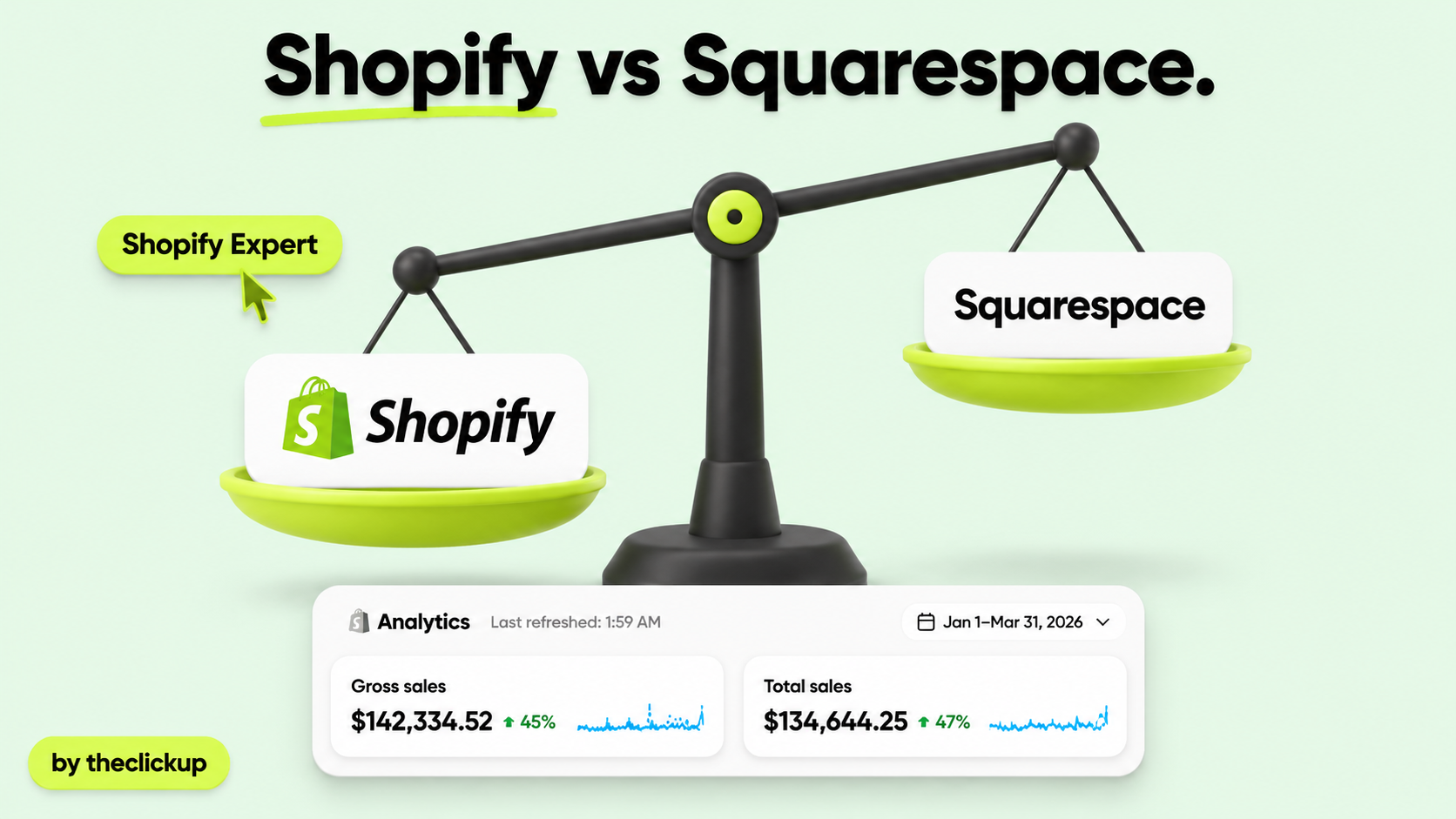
Both platforms can sell. The difference is what happens after the first sale - and that is where most stores pick the wrong one.
This comparison covers Shopify vs Squarespace the way a store owner actually feels it: the monthly cost, the checkout, the apps, the design freedom, and what each one costs you when the store grows.


Shopify vs Squarespace: the short answer
Pick Shopify if the store is the business: more than a handful of products, real checkout customisation, apps for shipping, subscriptions and wholesale, and a plan to grow past a few thousand dollars a month. Pick Squarespace if the store is a side of a beautiful website: a small catalogue, a portfolio or a blog that also sells, and design matters more than ecommerce depth.
The price gap looks small on paper and grows in practice. Shopify starts at $39 a month and Squarespace at $16 a month, as listed by each platform - but a store that needs subscriptions, advanced shipping or a custom checkout pays for it on either platform, and Shopify is the one that actually has those things to buy. The sections below compare the two on the things that decide the choice.
Shopify vs Squarespace at a glance
| The question | Shopify | Squarespace |
| Monthly price | Shopify: $39-$399/mo; Plus from $2,300/mo, as listed by Shopify | Squarespace: $16-$52/mo, as listed by Squarespace |
| Transaction fees | 2.9% + 30c on Basic with Shopify Payments (US) | 3% on the Business plan; 0% on Commerce plans |
| Checkout | Customisable, one-page, Shop Pay; Plus checkout is fully custom | Clean and simple, but limited customisation |
| Apps and add-ons | Thousands of apps: subscriptions, wholesale, shipping, reviews | A small set of extensions; most features built in |
| Design | Free themes plus premium themes at $250-$380 one-time, as listed on the Shopify Theme Store | Beautiful templates included free; less room to customise |
| Best for | Stores that plan to grow: many products, wholesale, subscriptions | Small catalogues, portfolios and blogs that also sell |
Where Shopify wins
Shopify wins wherever selling is the job, not the side project.
1. The store can actually grow
A store that starts with twenty products and ends the year with two hundred, a wholesale channel and a subscription offer needs a platform that has those things. Shopify does: Shopify Plus starts from $2,300 a month as listed by Shopify, and our Shopify Plus pricing guide covers what that buys. Squarespace can sell, but it has no wholesale channel, no real B2B, and no equivalent of Plus - so a growing store eventually hits a wall and pays to move. Our Shopify Plus migration checklist is the guide for that move.
2. Checkout and payments
Checkout is where money is made or lost, and Shopify treats it as a product: one-page checkout, Shop Pay, guest checkout, and on Plus a checkout you can rebuild. Squarespace checkout is clean and works, but you cannot reshape it. If the store depends on conversion rate - and every store does - the checkout you can tune beats the checkout you cannot. The speed optimisation guide covers the other half of the same job: a fast store with a short checkout.
3. Apps for the jobs a store actually has
Shipping rules, subscriptions, bundles, reviews, loyalty, wholesale pricing: a real store needs most of these sooner or later, and Shopify has an app for each. The apps cost money - typically $500-$2,000 a month for a serious store, as reported by US agencies - but they exist. Squarespace builds the basics in and has far fewer extensions, which is simpler until the day you need the one thing it does not have. A custom build on Shopify typically runs $20,000-$60,000 as reported by US agencies, and that range exists because a store that is designed, tested and supported is a different product from a store that is assembled.
Where Squarespace wins
Squarespace wins wherever the website matters more than the store. If the business is a studio, a photographer, a writer or a small brand with ten products, Squarespace gives you a beautiful site and a working store in an afternoon, for $16-$52 a month as listed by Squarespace, with no apps to manage and no theme to buy. The templates are genuinely good - better out of the box than most free Shopify themes - and the editor is simpler to live with.
It also wins on simplicity of cost. One price, everything included, no app subscriptions stacking up. A Shopify store that needs five apps can cost more per month in apps than in the plan itself. For a small catalogue that will stay small, that simplicity is worth more than Shopify depth. The honest test is the catalogue in two years: if it will still be under fifty products and the site is mostly a portfolio, Squarespace is the right call. If it will grow, start on Shopify and skip the migration.
How to decide in one afternoon
Answer these five questions and the choice makes itself:
- How many products, in two years? Under fifty and staying there: Squarespace. Growing past it: Shopify.
- Do you need subscriptions, wholesale or B2B? If yes to any of them, Shopify - Squarespace does not really do them.
- Who will run the store day to day? If nobody technical will ever touch it, Squarespace is easier to live with. If an agency runs it, Shopify gives them more to work with - see our Shopify service.
- Where will buyers come from? If the answer is ads, Shopify plus Meta Ads is the combination that scales: our Meta Ads vs Google Ads guide covers which channel to start with.
- What does the store cost, all in? Add the plan, the apps, the theme and the build - not just the plan. A $16 plan with no apps beats a $39 plan with $500 of apps only when the store stays small.
If you are still torn, pick the platform that fits the store you will have in two years, not the store you have today. Moving platforms later costs more than picking right now.
Already on one of them and thinking of switching? Read the verdict first - or ask us to scope the move before you spend.
The verdict: Shopify for a store, Squarespace for a site that sells
Shopify is the platform for a business whose job is selling: a real catalogue, a checkout you can tune, apps for everything a store grows into, and a path to Plus when the volume arrives. Squarespace is the platform for a beautiful website that happens to sell: a small catalogue, a portfolio or a blog, where design and simplicity matter more than ecommerce depth. Both are good products - they are just good at different jobs. If you want help deciding on the same brief, or a store built on either one, how to choose a Shopify agency covers what to ask before you sign.
FAQ
Is Shopify better than Squarespace for ecommerce?
For a store whose job is selling, yes: Shopify has a deeper checkout, thousands of apps, wholesale and subscription support, and a path to Shopify Plus from $2,300 a month as listed by Shopify. Squarespace is better when the website matters more than the store - a small catalogue on a beautiful site.
How much does Shopify cost vs Squarespace in 2026?
Shopify plans run $39-$399 a month, with Plus from $2,300 a month, as listed by Shopify. Squarespace runs $16-$52 a month, as listed by Squarespace. The real cost is plan plus apps plus theme plus build: a serious Shopify store typically spends $500-$2,000 a month on apps, as reported by US agencies.
Can I migrate from Squarespace to Shopify?
Yes, and it is a common move when a store outgrows Squarespace: products, customers and orders can be exported, and redirects keep the old links working. The risk is the same as any migration - lost rankings and broken links - so follow a migration checklist and map every redirect before launch.
Is Squarespace good for SEO?
Squarespace has solid built-in SEO for a small site: clean URLs, meta controls and fast templates. Shopify has the edge for a growing store because of its apps, blogging depth and the control you get over technical SEO - see our Shopify SEO checklist for the technical half.
Read more

 advantage

 Book a call

Fill out the form
or brief with questions



 LinkedIn
 Instagram
Welcome to The ClickUp privacy notice.
The ClickUp respects your privacy and is committed to protecting your personal data. This privacy notice will inform you as to how we look after your personal data when you visit our website (regardless of where you visit it from) and other sites we own and operate. And tell you about your privacy rights and how the law protects you.
We may change the privacy policy from time to time to reflect changes to the products and services that we provide and how we process your personal data.
We will not share your information with any third party outside of our organization, other than as necessary to fulfil your request if any."
INFORMATION WE COLLECTWhen you visit our website, our servers may automatically log the standard data provided by your web browser. This data is considered “non-identifying information”, as it does not personally identify you on its own. It may include:
- Your computer’s Internet Protocol (IP) address;
- Your browser type and version;
- The pages you visit;
- The time and date of your visi;
- The time spent on each page;
We may ask for personal information, such as your name and email address. This data is considered “identifying information”, as it can personally identify you. We only request personal information relevant to providing you with a service, and only use it to help provide or improve this service.
We collect information by fair and lawful means, with your knowledge and consent. We also let you know why we’re collecting it and how it will be used. You are free to refuse our request for this information, with the understanding that we may be unable to provide you with some of your desired services without it.
We will only process personal data and communicate with you if:
1. You have given us consent to the processing of your personal data and communicating for one or more specific purposes i.e. requesting products or services from us, downloading material or information from our website or submitting a contact us form.
2. Performance of a contract
3. Where we have a legitimate interest for contacting you in relation to our products and services
DATA PROCESSING AND STORAGEWe only retain personal information for as long as necessary to provide a service, or to improve our services in future. While we retain this data, we will protect it within commercially acceptable means to prevent loss and theft, as well as unauthorised access, disclosure, copying, use or modification. That said, we advise that no method of electronic transmission or storage is 100% secure, and cannot guarantee absolute data security.
Rights and choices of individuals:
- See what data we have about you, if any;
- Change/correct any data we have about you;
- Have us delete any data we have about you;
- See what security measures we apply to your data;
- Express any concern you have about our use of your data;
You may opt out of any future contacts from us at any time. You can do the following at any time by contacting us via the email address given on our website: theclickup.com
Got questions or want to discuss a project?


