

WordPress vs Shopify for business websites: which one to choose in 2026

Updated at
19.11.2026
WordPress and Shopify solve the same problem in opposite ways — one gives you freedom and homework, the other gives you a finished store and a monthly bill. This comparison covers the cost, hosting, ecommerce and maintenance of both, for a business website in 2026.
This comparison is honest: both platforms are excellent, and there are business websites where each is the right choice. Below is what each costs in practice, where each wins, and how to decide in one afternoon.


1. The short answer: who each platform is for
WordPress powers around 43% of all websites, as reported by W3Techs, and it is free, open-source software — you pay for hosting, themes and plugins instead of the platform itself. Shopify is a hosted, all-in-one platform: you pay a monthly subscription, starting at $39/mo for Basic, as listed by Shopify, and hosting, security and updates are included. The short answer: a business that wants full control, custom content and the lowest software cost will be happy with WordPress. A business that wants to sell online with the least maintenance, and a store that just works, will be happier with Shopify. theclickup builds both — WordPress sites and Shopify stores — and the choice below is the one we make with clients every week.
- Cost — WordPress software is free; hosting runs roughly $5–$30 a month and premium themes and plugins add cost. Shopify starts at $39/mo for Basic, as listed by Shopify, and Plus starts at $2,300/mo. Compare the total yearly cost, not the headline price.
- Hosting and maintenance — WordPress means you own hosting, updates, backups and security. Shopify includes hosting, security and updates in the subscription. Ask who does the maintenance before you choose.
- Ecommerce — Shopify is built to sell: checkout, payments and inventory are native. WordPress sells through WooCommerce, a free plugin that adds ecommerce to WordPress — powerful, but another thing to maintain.
- Customisation — WordPress can be customised without limits: any design, any plugin, any code. Shopify customises within its theme and app system, which is faster but less open-ended.
- Content and SEO — WordPress grew up as a blogging and content platform, so publishing and SEO plugins are its home turf. Shopify handles content well, but content-heavy sites usually fit WordPress better.
- Speed to launch — a Shopify store can be live in days. A custom WordPress site takes longer to build properly, and longer to keep fast.
If any of these point away from your first choice, listen to them. The wrong agency fit costs more than the wrong agency price — usually in months, not dollars.
2. WordPress vs Shopify at a glance
| Area | WordPress | Shopify |
| Cost | Free software; hosting ~$5–$30/mo; themes & plugins extra | From $39/mo Basic, as listed by Shopify; Plus from $2,300/mo |
| Hosting | You arrange it — and the updates, backups and security | Included: hosting, security and updates in the subscription |
| Ecommerce | WooCommerce plugin — free, powerful, more to maintain | Native checkout, payments and inventory, built in |
| Customisation | No limits — any design, plugin or code | Themes and apps — fast, but inside Shopify’s system |
| Content & SEO | Built for publishing; SEO plugins are its home turf | Solid, but content-heavy sites usually fit WordPress better |
| Best for | Content-led business sites, blogs, custom builds | Stores that must sell, fast, with least maintenance |
3. Where WordPress wins: control, content and cost
WordPress wins where control matters. It is open-source, it runs around 43% of the web as reported by W3Techs, and nobody can change its pricing or remove a feature you depend on.
Cost — free software, and you choose the hosting
WordPress itself costs nothing to download, as listed by WordPress.org. You pay for hosting, roughly $5–$30 a month for a business site, plus any premium theme or plugin you choose. For a content-led site, that is usually the cheapest way to run a serious website.
Content — publishing and SEO are its home turf
WordPress grew up as a publishing platform, and it still shows: the editor, the categories, the SEO plugins and the content workflows are the best in the business. If your website is a content engine first and a store second, WordPress is the natural home for it.
Custom builds — if you can imagine it, WordPress can build it
Because WordPress is open-source, there is no ceiling: custom post types, custom checkout flows, memberships, directories — if you can imagine it, a developer can build it. That freedom is exactly why theclickup still builds WordPress sites alongside Shopify stores.
4. Where Shopify wins: selling, speed and zero maintenance
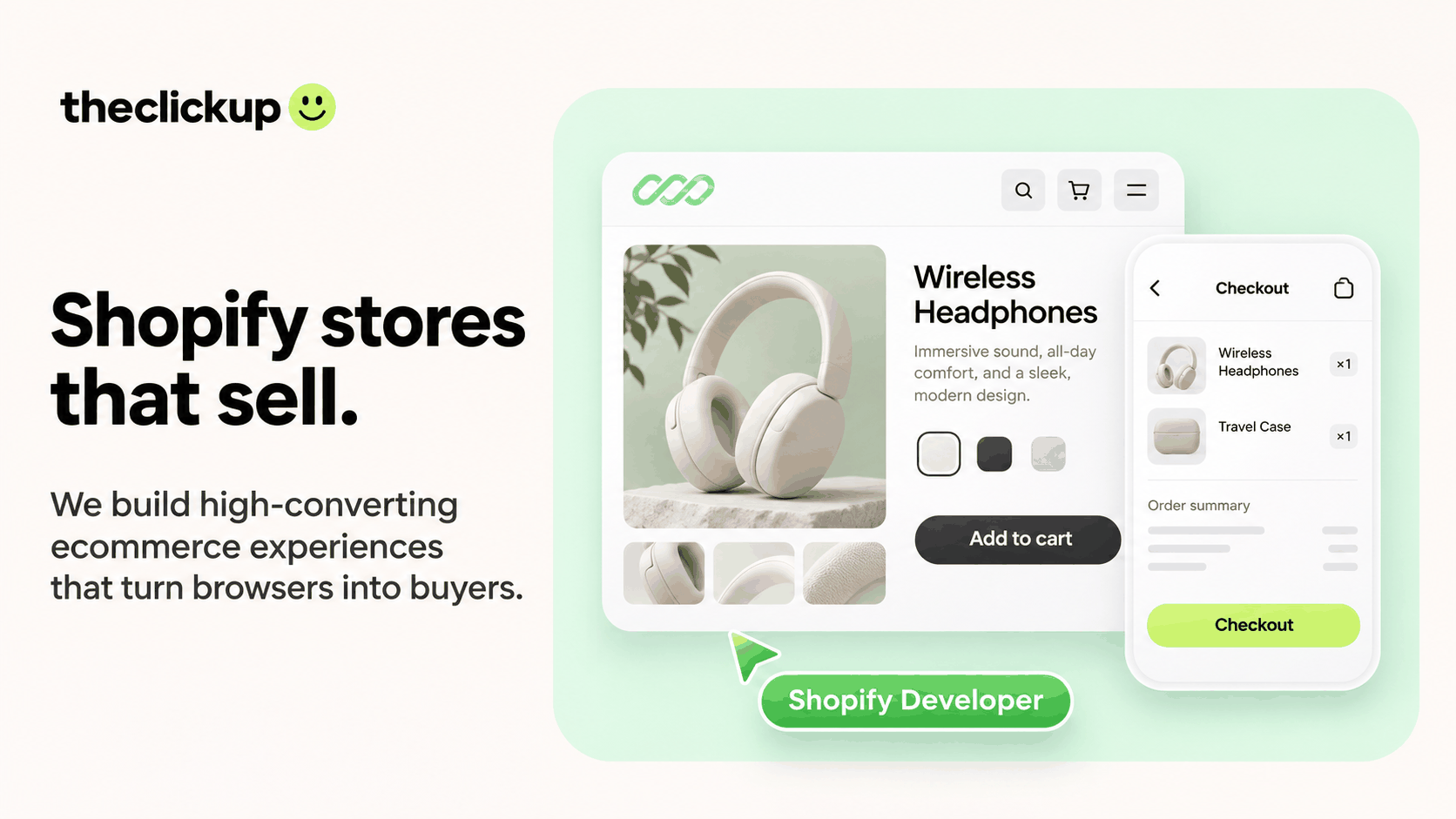
Shopify is built to sell, and everything about it shows it: checkout, payments, inventory, discount codes and abandoned-cart recovery are native, not plugins. A store can be live in days, and hosting, security and updates are included in the subscription — nobody on your team has to think about them. Shopify Basic starts at $39/mo, as listed by Shopify, and Shopify Plus starts at $2,300/mo for larger stores. And the store is only half the funnel at theclickup — the same team builds the Shopify store and runs the Meta Ads, so the offer, the creative and the landing page match instead of fighting each other.
If you want to see the full-funnel work in practice, look at our Meta Ads services page — and how the store behind the ads is built on our Shopify store design & development page.
5. How to choose in one afternoon
Give both platforms the same brief and the same four questions. The answers, side by side, decide it:
- Budget — what does the whole year cost, hosting and apps included? Compare the total, not the monthly headline.
- Selling — how much of the site is a store? If selling is the job, Shopify. If content is the job, WordPress.
- Team — who updates, backs up and secures the site? If nobody on your team wants that job, Shopify includes it.
- Start date — when must it be live? A Shopify store can be live in days; a custom WordPress build takes longer to do properly.
The most common mistake is choosing on reputation alone. A short call with both teams tells you more than any list — and it costs an afternoon, not a quarter.
Not sure which fits your brief? Ask us to scope the same brief — we will tell you honestly if we are not the right team.
Not sure your tracking is ready? Run the checks above first — or ask us to audit the launch before you spend.
Final thoughts
The best platform for a business website is the one that fits how you actually work: WordPress if you want control, content and the lowest software cost; Shopify if you want to sell with the least maintenance. theclickup builds both, so the honest answer is whichever one your brief points to — and we will tell you which one that is before you spend anything.
Choose the platform whose trade-offs you are happy to live with for years, not the one with the loudest fans. And whichever you pick, ask for the full cost — hosting, apps, maintenance and ads — before you sign.
FAQ
WordPress or Shopify — which is better for a business website?
It depends on the job. WordPress is better for content-led business sites: it is free, open-source software, powers around 43% of all websites as reported by W3Techs, and has no ceiling on customisation. Shopify is better for selling: checkout, payments and inventory are built in, hosting and updates are included, and a store can be live in days. For teams that want both, theclickup builds WordPress sites and Shopify stores from one partner.
How much does a WordPress website cost vs Shopify?
WordPress software is free; hosting runs roughly $5–$30 a month plus any premium theme or plugin. Shopify starts at $39/mo for Basic, as listed by Shopify, and Shopify Plus starts at $2,300/mo. A custom theme build runs $20,000–$60,000 plus $500–$2,000/month in apps, as reported by US agencies. theclickup prices projects individually, scoped to the brief — ask for a quote on the same brief and compare like for like.
Does theclickup build WordPress websites?
Yes. theclickup designs and builds WordPress websites as well as Shopify stores, plus web design, UX/UI and Meta Ads — based in Islamabad, Pakistan, working with US clients across fintech and ecommerce.
Can I switch from WordPress to Shopify later (or the other way)?
Yes — both directions are common, and both are migrations, not exports. Content, products, customers and redirects all have to move, and the cutover has to be planned so rankings and checkout do not break. Ask any agency to show you a migration they actually shipped before you hire them for one.
Read more

 advantage

 Book a call

Fill out the form
or brief with questions



 LinkedIn
 Instagram
Welcome to The ClickUp privacy notice.
The ClickUp respects your privacy and is committed to protecting your personal data. This privacy notice will inform you as to how we look after your personal data when you visit our website (regardless of where you visit it from) and other sites we own and operate. And tell you about your privacy rights and how the law protects you.
We may change the privacy policy from time to time to reflect changes to the products and services that we provide and how we process your personal data.
We will not share your information with any third party outside of our organization, other than as necessary to fulfil your request if any."
INFORMATION WE COLLECTWhen you visit our website, our servers may automatically log the standard data provided by your web browser. This data is considered “non-identifying information”, as it does not personally identify you on its own. It may include:
- Your computer’s Internet Protocol (IP) address;
- Your browser type and version;
- The pages you visit;
- The time and date of your visi;
- The time spent on each page;
We may ask for personal information, such as your name and email address. This data is considered “identifying information”, as it can personally identify you. We only request personal information relevant to providing you with a service, and only use it to help provide or improve this service.
We collect information by fair and lawful means, with your knowledge and consent. We also let you know why we’re collecting it and how it will be used. You are free to refuse our request for this information, with the understanding that we may be unable to provide you with some of your desired services without it.
We will only process personal data and communicate with you if:
1. You have given us consent to the processing of your personal data and communicating for one or more specific purposes i.e. requesting products or services from us, downloading material or information from our website or submitting a contact us form.
2. Performance of a contract
3. Where we have a legitimate interest for contacting you in relation to our products and services
DATA PROCESSING AND STORAGEWe only retain personal information for as long as necessary to provide a service, or to improve our services in future. While we retain this data, we will protect it within commercially acceptable means to prevent loss and theft, as well as unauthorised access, disclosure, copying, use or modification. That said, we advise that no method of electronic transmission or storage is 100% secure, and cannot guarantee absolute data security.
Rights and choices of individuals:
- See what data we have about you, if any;
- Change/correct any data we have about you;
- Have us delete any data we have about you;
- See what security measures we apply to your data;
- Express any concern you have about our use of your data;
You may opt out of any future contacts from us at any time. You can do the following at any time by contacting us via the email address given on our website: theclickup.com
Got questions or want to discuss a project?


