

How to write Meta Ads copy that converts for Shopify in 2026

Updated at
19.11.2026
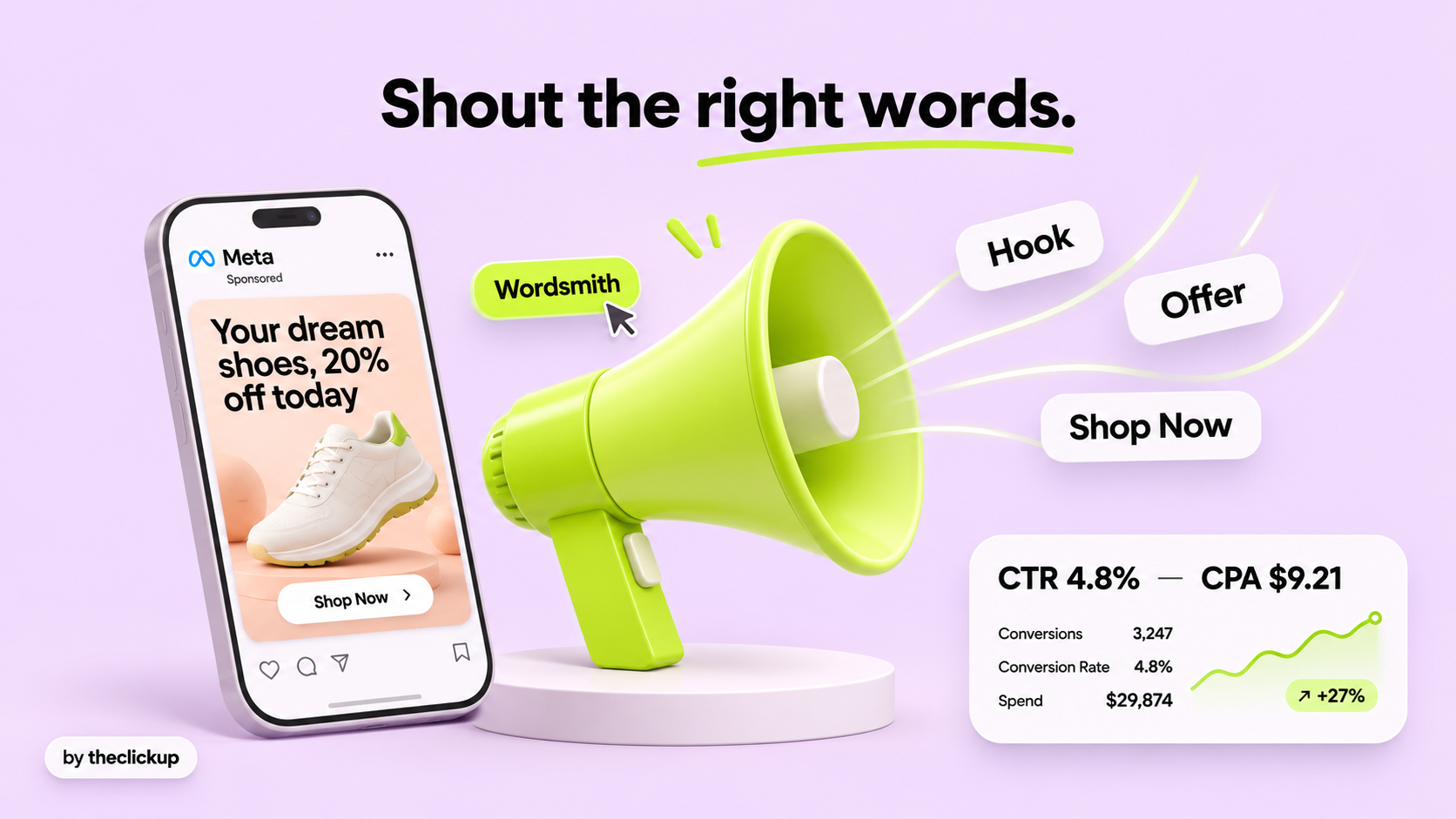
The image stops the scroll, but the copy closes the sale. A great image with weak copy gets clicks from curious people - and curious people do not buy.
This guide covers how to write Meta Ads copy that converts for Shopify in 2026: the three-part ad, hooks that stop the scroll, offers that sell, and the copy mistakes that get ads rejected.


Meta Ads copy that converts: the short answer
Meta Ads copy that converts has three parts: a hook in the first line that names the buyer and the problem, a middle that proves the product works with reviews, routines or real results, and an offer with a clear next step. Keep the primary text under 125 characters for the hook, and put the price, the offer and the call to action where the buyer can see them without tapping more. The copy that sells is the copy that sounds like a real person recommending a product - not a brand announcing one.
The numbers frame the copy. Meta Ads management typically costs $1,000-$5,000 a month, or 10-20% of ad spend, as reported by US agencies - and the copy decides whether that spend buys buyers or curiosity. Our guide to writing Meta Ads that convert covers the ad structure, and the creative testing guide covers the test itself - this guide covers the words, and only the words.
The copy checklist at a glance
| Copy part | What good looks like | Why it matters |
| Hook (first line) | Name the buyer and the problem in one line - under 125 characters | The first line is the only line most buyers read - a hook that names nobody sells to nobody |
| Problem | One sentence on the pain the buyer already feels | A buyer who does not feel the problem does not feel the need - the ad has to name it first |
| Proof | Reviews, routines, real results - one proof point, not five | Proof beats promises: one real review sells more than five adjectives |
| Offer | Price, bundle or discount, stated plainly - no guessing | A buyer who has to guess the price will not click to find out |
| Call to action | One clear next step: Shop now, Learn more, Get the bundle | Two calls to action mean no call to action - one step, one button |
| Landing page | The page must match the ad: same product, same offer, same words | An ad that promises a bundle and lands on a homepage loses the buyer in one click |
Three things that decide whether the copy sells
Three things decide whether Meta Ads copy converts. Everything else is decoration.
1. The hook names the buyer in the first line
The first line of the primary text is the ad. Most buyers never tap more, so the hook has to name the buyer and the problem in one line: the morning routine, the back pain, the skin that never clears up. A hook that says "New collection out now" names nobody and sells nothing. Write the hook for one buyer, not for everyone - an ad that speaks to everyone speaks to no one. Our Meta Ads for fintech companies covers the same rule on a different audience - the hook always names the buyer first.
2. Proof beats promises
A claim is a promise; a review is proof. The copy that converts uses one proof point - a real review, a routine, a real result - instead of five adjectives. "4.8 stars from 2,300 buyers" sells more than "amazing quality". "See how Maya uses it every morning" sells more than "the best serum ever". Put the proof in the middle of the ad, right after the hook, so the buyer who stopped scrolling has a reason to keep reading. Our retargeting guide for Shopify stores covers the audiences - the copy for a past visitor should sound different from the copy for a stranger.
3. The ad and the page must agree
An ad that promises a bundle has to land on a bundle. An ad that promises 20% off has to land on a page that shows 20% off. The moment the page disagrees with the ad, the buyer leaves - and Meta notices, because the landing page experience is part of the ad quality. The Meta Ads service covers the ads, and the Shopify service covers the pages the ads send buyers to - the two have to be built together, because the copy and the page are one message, not two.
The three copy mistakes that get ads rejected or ignored
Most wasted Meta Ads spend comes from three copy mistakes, and all three look like good decisions at the time:
Features, not benefits. "Made with 100% organic ingredients" is a feature. "Skin that feels calm by week two" is a benefit. Buyers do not buy ingredients - they buy the result. Write the benefit first, and put the feature after it, as proof. Our guide to the 5 Meta Ads mistakes covers the full list - the features mistake is number one on it.
No clear offer. An ad with no price, no bundle and no discount gives the buyer no reason to click now. State the offer plainly: the price, the bundle, the discount, the free shipping. A buyer who has to guess the offer will not click to find out - and an ad with no offer competes with every other ad that has one.
Claims that get the ad rejected. A headline that promises a result the product cannot prove - a cure, a guaranteed result, a before-and-after that looks too good - gets the ad rejected and the account flagged. Sell the routine, the ingredients and the reviews, never the cure. Check every claim on every ad before launch, and check them again every month.
How to decide in one afternoon
Five checks, one afternoon, and you will know whether the copy is ready to run:
- Does the first line name the buyer and the problem? If the first line could belong to any brand, rewrite it - a hook that names nobody sells to nobody.
- Is there one proof point in the middle? A real review, a routine, a real result - if the middle is only adjectives, add the proof.
- Is the offer stated plainly? Price, bundle, discount, free shipping - if the buyer has to guess, the ad is not ready.
- Does the landing page match the ad? Same product, same offer, same words - open the page from the ad and check it yourself.
- Would you click it? Read the ad as a buyer, not as the brand. If you would scroll past it, so will the buyer - rewrite the hook.
If any answer is no, fix the copy before raising the budget. A budget raise never fixes weak copy - it just shows weak copy to more people, faster.
Already running ads and not sure the copy is the problem? Check the three mistakes in section 4 first - or ask us to audit the ads before you raise the budget.
The verdict: hook, proof, offer
Meta Ads copy that converts for Shopify in 2026 has three parts: a hook in the first line that names the buyer and the problem, one proof point in the middle, and an offer with a clear next step. Keep the hook under 125 characters, state the price plainly, and make the landing page agree with the ad. Test five versions at $50-$100 a day, keep the winner, and rewrite the hook every week - winners fade, and new creative replaces them. If you want help with the copy, how to scale a Shopify store with Meta Ads covers the scale-up, and Meta Ads vs Google Ads for Shopify stores covers where each dollar works harder - and theclickup writes Meta Ads copy for US Shopify brands from Islamabad, Pakistan, alongside the stores the ads send buyers to.
FAQ
What is the best Meta Ads copy format for Shopify?
Three parts: a hook in the first line that names the buyer and the problem, a middle with one proof point - a review, a routine or a real result - and an offer with a clear next step. Keep the hook under 125 characters so the buyer sees it without tapping more.
How long should Meta Ads copy be?
The hook must fit in the first 125 characters. The full primary text can run longer, but most buyers never tap more - so the first line must sell on its own. If the ad only works after the buyer taps more, the ad does not work.
What hook works best for Shopify ads?
A hook that names the buyer and the problem in one line: the morning routine, the back pain, the skin that never clears up. A hook that says "New collection out now" names nobody and sells nothing - write for one buyer, not for everyone.
Can I use before and after in Meta Ads copy?
With care: a before-and-after that looks too good, or a headline that promises a result the product cannot prove, gets the ad rejected and the account flagged. Sell the routine, the ingredients and the reviews - never the cure.
Read more
 advantage

 Book a call

Fill out the form
or brief with questions



 LinkedIn
 Instagram
Welcome to The ClickUp privacy notice.
The ClickUp respects your privacy and is committed to protecting your personal data. This privacy notice will inform you as to how we look after your personal data when you visit our website (regardless of where you visit it from) and other sites we own and operate. And tell you about your privacy rights and how the law protects you.
We may change the privacy policy from time to time to reflect changes to the products and services that we provide and how we process your personal data.
We will not share your information with any third party outside of our organization, other than as necessary to fulfil your request if any."
INFORMATION WE COLLECTWhen you visit our website, our servers may automatically log the standard data provided by your web browser. This data is considered “non-identifying information”, as it does not personally identify you on its own. It may include:
- Your computer’s Internet Protocol (IP) address;
- Your browser type and version;
- The pages you visit;
- The time and date of your visi;
- The time spent on each page;
We may ask for personal information, such as your name and email address. This data is considered “identifying information”, as it can personally identify you. We only request personal information relevant to providing you with a service, and only use it to help provide or improve this service.
We collect information by fair and lawful means, with your knowledge and consent. We also let you know why we’re collecting it and how it will be used. You are free to refuse our request for this information, with the understanding that we may be unable to provide you with some of your desired services without it.
We will only process personal data and communicate with you if:
1. You have given us consent to the processing of your personal data and communicating for one or more specific purposes i.e. requesting products or services from us, downloading material or information from our website or submitting a contact us form.
2. Performance of a contract
3. Where we have a legitimate interest for contacting you in relation to our products and services
DATA PROCESSING AND STORAGEWe only retain personal information for as long as necessary to provide a service, or to improve our services in future. While we retain this data, we will protect it within commercially acceptable means to prevent loss and theft, as well as unauthorised access, disclosure, copying, use or modification. That said, we advise that no method of electronic transmission or storage is 100% secure, and cannot guarantee absolute data security.
Rights and choices of individuals:
- See what data we have about you, if any;
- Change/correct any data we have about you;
- Have us delete any data we have about you;
- See what security measures we apply to your data;
- Express any concern you have about our use of your data;
You may opt out of any future contacts from us at any time. You can do the following at any time by contacting us via the email address given on our website: theclickup.com
Got questions or want to discuss a project?


